The entrance to the Huron-Wendat Museum in Wendake, Quebec.
By Lauren-Rose Stunell
Writing about Indigenous cultures on Turtle Island is so unique because every nation, person, and land holds its own stories and traditions that deserve to be honoured. However, through each Indigenous language that we highlight in our Discovering Languages series, one thing remains consistent. Language is far more than words: it carries worldview, identity, history, and ways of relating to one another and the land.
Honouring Language and Family
Traditionally spoken by the Wendat Nation, whose ancestral territory includes what we now know as Ontario, Quebec, and the Great Lakes Region, the Wendat language is part of the Iroquoian language family. The language and the people are also sometimes referred to as Huron-Wendat (the French gave them the nickname “Huron”). Before European contact, the Wendat lived in large villages made up of longhouses where extended families lived together. This message of community, co-operation, and a shared responsibility to our loved ones calls us to reflect on the importance of family.
The Three Sisters
Another sign of the importance of family in Wendat culture is the concept of the “Three Sisters.” The Wendat were skilled farmers and would plant the Three Sisters — corn, beans, and squash — together since they would support each other in their growth. The corn provides a tall stalk for the beans to climb, the beans return nutrients to the soil, and the squash spreads along the ground to retain moisture and protect against weeds.
What I love most about teaching students about the Three Sisters is not just the agricultural knowledge, but the lesson it carries about interdependence, balance, and community. Students immediately connect this idea to their own lives and how people need one another, how strengths differ, and how success is shared rather than individual. The Three Sisters became more than crops; they became a living metaphor for co-operation, respect, and responsibility. Indigenous knowledge systems teach lessons like this that are just as meaningful today as they were generations ago.
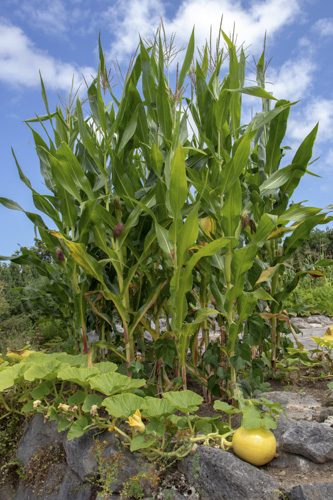
Having two sisters of my own, the Three Sisters remind me consistently of the power of togetherness and the need for support in order to thrive. Similarly, Wendat society was traditionally matrilineal, meaning family lineage and clan membership were passed down through the mother. Women played central roles in community life, including decision making, agriculture, and the selection of leaders. Who runs the world? Girls!
Language Isn’t Just History — It’s Our Present and Future
Unfortunately, the Wendat language was deeply impacted by colonization, displacement, and the forced residential school system. By the late 1800s, it was no longer spoken as a first language. However, the Wendat Nation — specifically in Wendake, Quebec — has made inspiring moves to revive it.
The Wendat have shown great resilience and dedication to their ancestors by using historical records, missionary dictionaries, and community knowledge and stories to revive the Wendat language. Impressively, linguists and Wendat community members have been working together in an act of reconciliation and revitalization to reconstruct vocabulary, grammar, and pronunciation to ensure that the language is taught in a way that honours its roots.
The powerful message that every Canadian should hear in progressing towards reconciliation is that Indigenous languages are not a part of the past — they belong in the present and the future. By following the teachings of the Three Sisters, we can work together to support and revitalize Wendat and other Indigenous languages.
Expressing the Teachings of the Three Sisters Through Art
Introduction and Description
Following Alberta’s Grade 6 social studies curriculum, I have taught about the matrilineal, democratic values of the Wendat people and the values portrayed by the Three Sisters. One teaching moment that will stay with me is the power and relevance of the message behind the Three Sisters. This lesson will bring together the science behind the agriculture, the values of togetherness, and the Wendat language to help bring reconciliation into your classroom or educational space.
Learning Intentions
In this activity, learners will:
- Understand the Three Sisters teaching through story in the target language
- Create a visual representation of corn, beans, and squash
- Research and label each plant using its name in the target language and in Wendat
- Explain why reviving Indigenous languages is important through an artist statement
This lesson matters because it centres Indigenous storytelling and knowledge systems while integrating art, language, and research. Learners will be able to build an understanding of reconciliation and language revitalization, encouraging them to see languages as meaningful and living.
Activity Sequence
- Begin by sharing a Three Sisters story in the target language, emphasizing that stories are how Indigenous knowledge is passed down through generations. It is important for learners to understand the following message before moving onto the next step:
- The Three Sisters are traditionally planted together by many Indigenous Nations, including the Wendat, because each plant supports the others. Corn supports beans, beans nourish the soil, and squash protects the ground.
- Discuss the story in the target language. Discussion questions for group settings could include the following:
- What lesson does the Three Sisters story teach us?
- How does language carry culture and knowledge?
- Why is reviving Indigenous languages important now?
- Have students create a visual artwork that represents the Three Sisters growing together and supporting one another. Students can challenge themselves to find a way to represent how each plant helps the other.
- Students should choose a title for their piece in the target language that reflects the message of the Three Sisters. They should write the names of the Three Sisters in the target language and in Wendat. (The names of the crops in Wendat can be found in the Wendat Dictionary developed by the Centre de développement de la formation et de la main-d’œuvre huron-wendat.)
- Students should write an artist statement about their visuals in the target language to showcase their understanding and why reviving the Wendat language is important.
Extension and Conclusion
To build a sense of community and togetherness, students can participate in a gallery walk to share each other’s ideas, learning, and statements. Students can be guided to reflect on what they learned and how they can continue their own reconciliation journeys by including Indigenous languages in daily life.