A street view in Old Montreal
By Rebecca Schmor
The first time I visited Caffè Italia on Saint-Laurent Boulevard in Montreal, it was like walking into a lively language exchange. The barista greeted me in English, took my order in French, and gave instructions to his colleague in Italian. The café was buzzing with equally multilingual interactions, with a combination of local students, regular retirees, and visiting tourists.
Caffè Italia’s modern-day multilingual milieu is an emblem of Quebec’s history of Italian immigration, one marked by war-era relocation, family reunification, and ongoing language evolution. The early settlers of Montreal’s Little Italy were joined by a wave of Italian immigration after World War II, which brought a mix of language varieties from the Southern Italian regions of Calabria, Sicily, and Molise.
Franitaliese
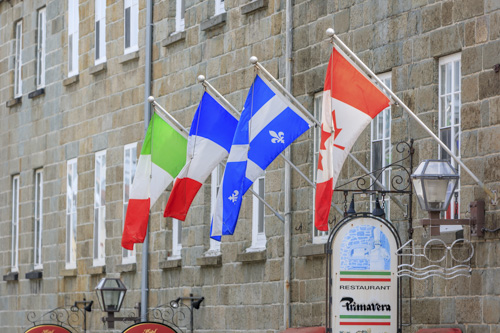
These Italian language varieties soon mixed with the surrounding French and English and helped to bridge communication gaps in Quebec’s growing Italian community. The unique linguistic mix that resulted is referred to as Franitaliese (coming from the Italian words for French, Italian, and English: francese, italiano, inglese). Franitaliese can be considered a sociolect, characterized by code-switching, loanwords, and word-for-word translations. It features both an adoption of French and English in Italian and an Italianization of French and English.
The adoption of French and English by Montreal’s Little Italy community is especially noticeable in words for modern appliances, bureaucratic terms, or Canadian concepts. For example, frizza may be used to refer to a freezer instead of the modern standard Italian word congelatore. The French pronouns “nous” (we) and “vous” (you plural) may be used instead of noi and voi. A conversation overheard on the streets of Little Italy could sound like this: “ho ricevuto (Italian: I received) la bill (English: the bill), cinq cents dollars, c’est trop (French: 500 dollars, it’s too high), capisci (Italian: you know), faut appeler Hydro-Québec (French: I have to call Hydro-Quebec) subito (Italian: right away).”
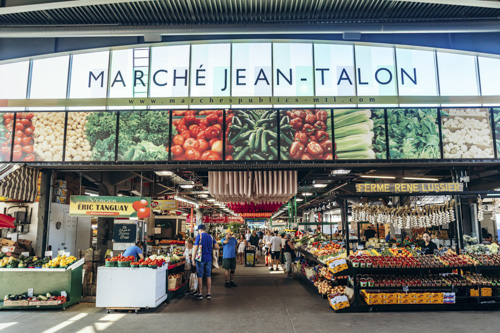
Over time, the development of Franitaliese has become a unique marker of linguistic and cultural identity. It reflects histories of local immigration and global modernization. Quebec’s Italian immigrants, many of whom came to build the tracchi (train tracks) in Canada, may not be understood by their counterparts in Italy working on the binari. While camion (trucks) in Italy have a targa (license plate), the trucchi (from the English “trucks”) in Montreal have a placca (from the French “plaque”). As with language blends like Spanglish (Spanish and English), Portuñol (Portuguese and Spanish), or Chinglish (Chinese and English), Franitaliese reflects linguistic creativity, cultural hybridity, and local identity.
Read on to explore Franitaliese and other international language blends in the adaptable classroom activity below.
Language Mix Quiz
Activity Description
In this activity, learners infer the meaning of “Franitaliese” words and work together to create a quiz for their classmates on another language mix of their choice. This activity is designed for advanced language learners at the university level but can be adapted to other proficiency levels or contexts. Possible extensions include inviting learners to discuss their own code-switching or language mixing experiences, or pre-teaching inference strategies like guessing from context or identifying parts of speech.
Activity Steps
In contexts of cultural hybridity, language mixing emerges. Linguistic codes like “Franglais” and “Spanglish” represent a combination of code-switching, accented speech, and novel lexicon. At their core, they embody hybrid linguistic and cultural identities. With your group, you will investigate a language mix of your choice and create a quiz for your classmates.
- With your group, work together to infer the meaning of the following Franitaliese words: grosseria, parchegger, carro, ascensore, bisne, placca, and trucchi. You can draw on inference cues such as cognates, prefixes and suffixes, or parts of speech. You can also look up the meaning of words in English, French, and Italian.
- Together, choose another language mix (e.g., Hinglish, Denglish, Chinglish, Taglish, Manglish, Runglish, Portuñol). As a class, make sure each group has chosen something different. Conduct preliminary online research to learn more about your chosen language mix. Make note of interesting words or phrases.
- Create a quiz of 5–10 words or phrases for your classmates on your chosen language mix. Make sure you have a copy of the answers.
- With your new jigsaw group (one person from every group in the class), take turns sharing and guessing the meaning of the words in your quizzes. Before you take each other’s quizzes, share some background information about your chosen language mix.
- Back in your original group, reflect together on the strategies you used to guess the meaning of the words when taking the other groups’ quizzes.
- Share your best inference strategies with the whole class.
Activity Commentary
This activity engages learners in dynamic collaboration, metalinguistic cognition, and multilingual awareness. To select a language mix and develop a group quiz, learners must assess options, negotiate preferences, and make collective decisions. This activates both agency and co-operation. In inferring the meaning of unfamiliar words, learners must enact metalinguistic strategies while tolerating ambiguity. As learners engage with the phenomena of language mixing and novel lexicon, they enhance their awareness of multilingual practices and cultural hybridity.