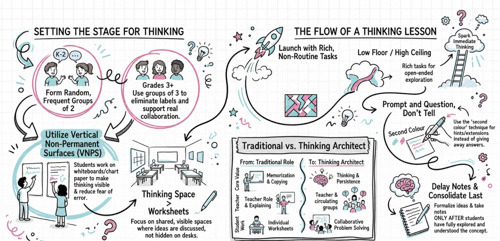
The goal is not just to teach a language, but to create the conditions for students to think, communicate, and thrive in that language.
By Paulina Villarreal
As teachers, we are told to shift our instruction from delivering content to fostering deep thinking learning. Inspired by Building Thinking Classrooms in Mathematics by Peter Liljedahl, this approach can be effectively adapted to additional language (L+) learning contexts. Rather than asking students to memorize vocabulary or follow rigid sentence structures, we can design learning environments where students actively think, explore, and communicate in the target language.
These practical strategies create a thinking classroom in language learning, where students develop autonomy, confidence, and meaningful communication skills.
From Telling to Designing Thinking
The central idea behind thinking classrooms is simple but impactful: the goal is not to teach better, but to create the conditions for students to think better.
In a traditional language classroom, the teacher often models language, provides vocabulary lists, and guides students step by step. In contrast, a thinking classroom shifts the teacher’s role. The teacher becomes the designer of rich learning experiences, allowing students to explore language through interaction, problem-solving, and discussion.
Using Rich Tasks in Language Learning
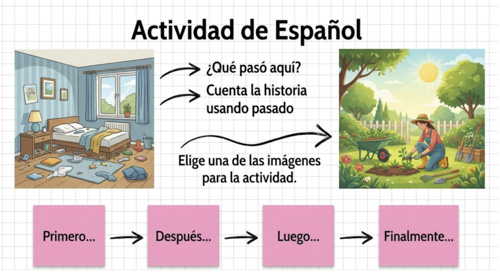
A key element of this approach is the use of rich tasks. This means using open-ended prompts that encourage multiple responses and spark discussion between students.
In language learning, rich tasks can include the following:
- Images that prompt observation and description
- Incomplete sentences that require creative completion
- Real-life scenarios that invite authentic communication
For example:
- “What do you see in this spring image?”
- “In the spring, I see…”
- “Describe what is happening and why.”
These tasks shift the focus from correctness to meaning making, encouraging students to take risks and engage more deeply with the language.
Vertical Non-Permanent Surfaces
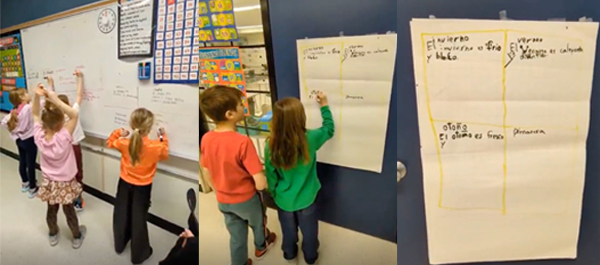
In a thinking classroom, one of the most impactful strategies is having students work on vertical, non-permanent surfaces.
Instead of having students sit down and write in their notebooks, having them standing up and using non-permanent surfaces (whiteboards, blackboards, flipcharts) allows the teacher to observe such things as:
- Increased participation and energy
- More visible thinking; students can SEE what they are capable of accomplishing
- Greater willingness to take risks
Students are more likely to try, revise, and discuss their ideas when they can easily erase and adjust their work. In a language classroom, this might look like students collaboratively building sentences, brainstorming vocabulary, or responding to prompts in real time.
Collaborative Learning Through Random Groups
Group work is essential in a thinking classroom, but HOW groups are formed matters. Most teachers will create their groups based on student abilities or will arrange groups that lead to better productivity. In a thinking classroom, students are placed in visibly random groups. This means that students must see they are random groups, using either popsicle sticks with their names, dice, playing cards, or another method where students can see the randomness of group creation.
Randoms groups are essential because they:
- Reduce dependency on stronger students
- Eliminate social barriers and reduce social stress
- Promote authentic collaboration
- Increase enthusiasm for learning
- Empower every student to participate
How many students per group? For K–Grade 2, pairs work best. For Grade 3 and above groups of three are ideal.
The Power of Giving Only One Marker Per Group
If every student has their own marker, the task quickly becomes individual work. In a thinking classroom, each group shares only ONE marker. This is how it works: the teacher sets a timer for about 1–2 minutes, and every time it goes off, the student holding the marker must pass it to a teammate, who then continues the work.
This structure promotes genuine collaboration, as all students must stay engaged and aware of the group’s thinking, knowing their turn is coming next. In this moment, learning becomes visible, as students build on each other’s ideas and contribute collectively to the task. If a teammate needs help, the group can support them with ideas, spelling, or grammar; however, only the person whose turn it is may use the marker.
The Role of Errors
In a thinking classroom, errors are not something to avoid, they are essential to learning. Teachers should create a classroom culture where:
- Trying is valued more than being correct
- Process matters more than speed
- Mistakes are seen as opportunities
Students often hesitate to speak and write due to fear of making mistakes. By normalizing errors, we create a safer space for communication and risk-taking.
The Teacher’s Role: Observe and Guide
Instead of leading from the front, in a thinking classroom the teacher circulates throughout the classroom, observing, listening, and intervening strategically. Since each group is using only one marker, the teacher should use a different coloured marker to add hints, highlight key vocabulary, gently correct, or extend ideas.
Importantly, the teacher does not erase student work. This preserves student thinking and encourages ownership.
Consolidating Learning
While a thinking classroom is student-driven exploration, consolidation is teacher-guided. It is important that at the end of the lesson, the teacher brings the class together to highlight key ideas or terms or formalize language structures.
This is the moment for brief, focused direct instruction, ensuring that students leave with clarity and reinforced understanding.
Creating a thinking classroom in language learning is not about adding more activities; it is about changing how we design learning. By using rich tasks, promoting collaboration, embracing errors, and shifting our role as teachers, we empower students to become confident, independent language learners.
Ultimately, the goal is simple: not just to teach a language, but to create the conditions for students to think, communicate, and thrive in that language.