Cabot Trail, Cape Breton Island, Nova Scotia.
By Rebecca Schmor
After a century-long wave of migration from the Scottish Highlands and Islands, Gaelic was the third most spoken language in Canada by 1900. Since this peak, Canada’s population of Scottish Gaelic speakers has been heavily concentrated in Nova Scotia (New Scotland), especially on Cape Breton Island, where the rugged, isolated terrain helped the language community survive.
Nova Scotia is the only place outside of Europe where Scottish Gaelic is still spoken as a community language, with an official Office of Gaelic Affairs and a Gaelic College in St. Ann’s. These linguistic preservation efforts predate Scotland’s own 2025 recognition of Gaelic as an official national language. In light of intense revitalization efforts, Gaelic is currently classified as an endangered language in a state of “fragile growth,” with many adult Gaels reclaiming their heritage language.
I interviewed Paul Meighan (Pòl Miadhachàin), a Scottish Gael residing in Canada, to learn about his language reclamation journey. Here is what he had to say.
Can you describe your journey learning Scottish Gaelic?
I was born and raised in Glasgow by my late mother, Angusina MacGillivray of South Uist, one of the Gaelic heartlands. Scottish Gaelic is my ancestral language and a core part of my identity. It is also an endangered indigenous language in Scotland with around 70,000 speakers. Growing up, I often heard Gaelic around my fluent-speaking grandmother, Dolina Walker, who — like many Gaels — moved from Uist to Glasgow for work. Yet I could not learn Gaelic in the mainstream education system, where only English, Spanish, or French were offered. Older relatives recall being beaten for speaking Gaelic, and this violence — along with the legacies of the Highland Clearances and discriminatory policies excluding Gaelic from schools — profoundly disrupted intergenerational transmission. When I once asked my grandmother to teach me, she said I did not “need it.”
I have always wanted to learn — or remember — my language. Beginning my PhD in Indigenous language revitalization at McGill in 2019 motivated a conscious decision to reclaim Gaelic more fully. Digital tools were pivotal: I took online classes during the COVID-19 pandemic and learned with Gaelic organizations such as Ceòlas in South Uist. Grammar initially felt daunting, but learning more about Gaelic culture — song, storytelling, and history — resonated deeply and sustained my motivation. Today, I engage with Gaelic daily and study through a Gaelic-medium Diploma of Higher Education at Sabhal Mòr Ostaig. As a Gael sociolinguist, Gaelic informs how I understand language, identity, land, and my responsibilities as an immigrant guest on Indigenous lands in Canada.
What is your experience with Scottish Gaelic in Canada?
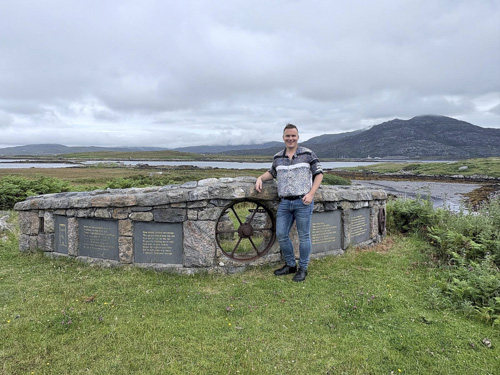
My experience with Gaelic in Canada has been as a recent immigrant and as a reclaimer, learner, and researcher in diaspora. I’ve learned that Gaelic has been spoken on Turtle Island since the 18th century and today has around 2,200 speakers, most living in Mi’kma’ki (specifically Nova Scotia), often described as the only living Gaelic community outside of Scotland.
This history reminds me of the TRC Calls to Action and the need to acknowledge colonial harms and change behaviours. Many Gaels displaced by the Highland Clearances later became settlers implicated in the displacement of the Mi’kmaq who helped them settle. For me — and as with other non-Indigenous languages in Canada — Gaelic sits alongside, and must never overshadow, the Indigenous languages of these lands. It is encouraging to see initiatives in Mi’kma’ki and Unama’ki (Cape Breton) — such as the Barra Strait Mi’kmaq Friendship Festival and the appointment of the first L’nu Interpretative Lead, John Sylliboy, at Cape Breton’s Highland Village — aimed at bridging cultures and strengthening good relations between Gaels and the Mi’kmaq.
In Toronto, I’ve encountered Gaelic through the Gaelic Society and met fluent new speakers. I’ve also learned about immersive initiatives in Nova Scotia, such as An Àirigh (The Shieling), a four-month live-in immersion program using the Gàidhlig aig Baile (Gaelic in the Home) methodology. I’ve been fortunate to connect with wonderful people in Gaelic revitalization there, including Shannon MacMullin of the Nova Scotia Office of Gaelic Affairs and Kenneth MacKenzie, a renowned piper and fiddler. Kenneth serves as Director of Education and VP of Beinn Mhàbu at Colaisde na Gàidhlig. He is also a founding Director of Taigh Sgoile na Drochaide — the first Gaelic immersion school outside Scotland. And his father is from my own home island of South Uist. ’S e saoghal beag a th’ ann an saoghal na Gàidhlig! The Gaelic world is a small one.
What are your favourite Gaelic words?
Dùthchas evokes kinship, belonging to the land rather than “owning” the land, and a sense of responsibility.
Cèilidh means “a visit” — gathering to share stories, songs, laughter, and care.
Both fill me with hope for the future of Gaelic and other indigenous languages and remind me that languages live through relationships, not just classrooms and textbooks.
Language Biography Interview
Activity Description
In this group activity, each learner interviews a classmate outside of their group regarding their language biography and then writes a collective report with their group. This activity is designed for advanced language learners at the high school level or higher but can be adapted to other proficiency levels or contexts. Possible adaptations include inviting learners to write their own language biography report or interview a community member and share their report with the class. The reports could also be collected and curated in a collective e-book or blog format.
Activity Steps
You will each interview a classmate to learn about their language learning background and then write a collective report with your group.
- With your group members, create a series of interview questions in the target language. You may want to ask about home language use, language learning experiences, language learning methods, or future language learning aspirations. You can read the blog post above for inspiration.
- Line up as a class in two equal rows and interview the classmate standing across from you. Make sure to take notes as you listen to their answers to your questions.
- Return to your group and take turns sharing the answers you received.
- Together with your group, synthesize the interview responses into one written report. You can write about common themes or include quotes from specific classmates. Make sure your report is one integrated story and not a summary of disjointed answers.
- Exchange your report with another group and help them improve it by giving feedback on their writing. First, decide as a class what kind of feedback is most helpful (e.g., word choices, grammatical structures, order of ideas).
- With your teacher, reflect on the written interview reports. What were some strengths? What could be improved next time?
Activity Commentary
This activity promotes collective autonomy, higher order thinking skills, and reflection. Students are free to create their own interview questions but must also agree on these questions as a group. In putting together multiple interview responses, they enact sophisticated cognitive functioning skills like synthesis, selection, and storytelling. They further hone these skills through a reflective debrief that helps raise metalinguistic awareness and integrate learned insights.